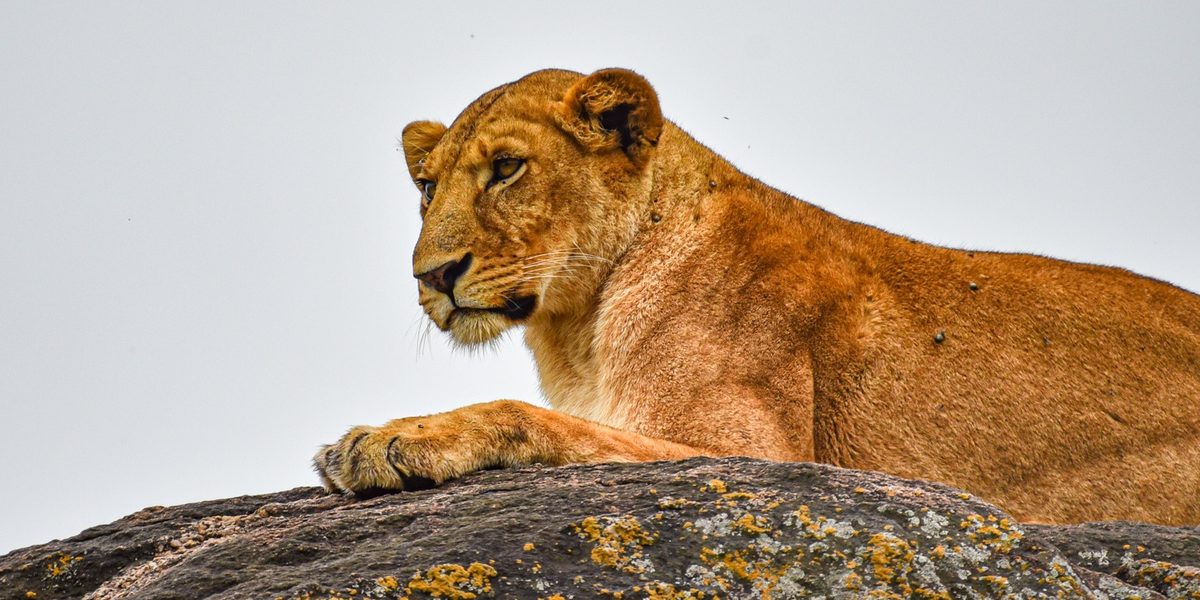
The African lion (Panthera leo) holds an unrivaled reputation as the undisputed ‘king of the beasts’. In Uganda, these apex predators are a major symbol of strength and one of the most highly sought-after species by wildlife enthusiasts worldwide.
From the sweeping, palm-studded valleys of Kidepo to the dense acacia woodlands of the Ishasha sector, a safari in Uganda offers a profoundly different and more intimate experience than the crowded reserves of East and Southern Africa.
But what exactly makes the lions of Uganda so special? Why are they declining? And most importantly, how can you responsibly witness these big cats in their natural habitat? Read on as we dive deep into the world of Uganda’s majestic lions.
Where to Find Lions in Uganda: The Big Three National Parks
Uganda is home to three distinct lion populations, each residing in a remarkably different ecosystem. If you want to spot them, these are the primary destinations:
1. Queen Elizabeth National Park (QENP)
Located in the western region of the country, QENP is the most famous sanctuary for lions in Uganda. The park is renowned worldwide for its Ishasha tree-climbing lions. Unlike lions in other parts of Africa, these unique big cats spend their afternoons lazily draped across the branches of large fig and acacia trees.
- Why they climb: Researchers suggest this behavior helps them escape midday heat on the ground and avoid pestering bites from tsetse flies.
- Habitat: Open savannah, dense thickets, and crater lakes.
2. Murchison Falls National Park (MFNP)
Bisected by the mighty Victoria Nile, MFNP is Uganda’s largest national park and currently harbors the highest concentration of lions in the country. Recent carnivore surveys estimate over 200 lions reside within this vast, 3,200-square-kilometer reserve.
- The Hunt: The park’s varied terrain, featuring Borassus palm savannah and sweeping grasslands, provides an ideal hunting ground where lions target Uganda kobs, buffaloes, and warthogs.
3. Kidepo Valley National Park
Nestled in the remote, semi-arid extreme northeast of Uganda, Kidepo is arguably the most breathtaking of the country’s parks. Once a booming stronghold for the species, the lion population here has seen steep declines. Nevertheless, spotting a black-maned male lion perched upon the park’s rocky kopjes (outcrops) is a quintessential ‘Lion King’ moment.
The Exclusive Lion Tracking Experience in Queen Elizabeth National Park
For the ultimate enthusiast, a standard game drive simply isn’t enough. In Queen Elizabeth National Park, the Uganda Wildlife Authority (UWA) in conjunction with the Uganda Carnivore Program (UCP) offers a highly exclusive, research-based Lion Tracking Experience.
What is it?
Rather than aimlessly driving hoping for a chance encounter, you join dedicated wildlife researchers and conservationists in the field. Many of the lions in QENP are fitted with radio collars. Using directional tracking equipment, you will actively locate a specific pride.
What can you expect?
- Intimacy: Because you are off the main tourist tracks, your time with the lions is private, quiet, and unhurried.
- Education: Researchers will teach you about the pride’s social structure, home ranges, and biology.
- Contribution: The funds from your tracking permit go directly into the Uganda Carnivore Program to purchase radio collars, pay for veterinary interventions, and fund community education.
The Current Status: The Alarming Nationwide Decline
While lions are the pride of Uganda’s wildlife tourism sector, their populations are undergoing a concerning decline. Historically, Uganda boasted nearly 500 lions, but national census figures released by the Ministry of Tourism, Wildlife and Antiquities show a steep drop, with current population estimates falling to around 292 individuals nationwide.
Researchers point to a few critical drivers behind this decline:
1. Human-Wildlife Conflict
As human settlements expand and agricultural land encroaches on protected areas, interactions between pastoralists and lions increase. When lions prey on livestock—such as cattle or goats—local pastoralists sometimes resort to retaliatory killings, often by lacing animal carcasses with toxic agricultural poisons. This indiscriminately kills not only the lions, but also endangered vultures, hyenas, and other scavengers.
2. Snaring and Poaching
In parks like Murchison Falls, snares set by illegal poachers hunting for antelopes frequently catch lions as bycatch. These snares cause severe injuries, infections, or a slow, agonizing death.
3. Prey Depletion
Lions require a healthy population of herbivores to thrive. When poaching diminishes the natural prey base within the parks, lions struggle to feed themselves and their cubs, leading to higher rates of cub mortality and malnourishment.
Why Protecting Uganda’s Lions is Essential
Why should the global community care about the declining lion populations in Uganda? The answer lies in both ecology and economics.
Ecological Importance
Lions are a keystone species. As top predators, they regulate the populations of large herbivores like buffaloes, zebras, and antelopes. By preying on the weak, sick, and old, lions prevent overgrazing, ensure the survival of robust vegetation, and limit the spread of diseases within herbivore herds. Their presence maintains a healthy, balanced ecosystem for hundreds of other species.
Economic Livelihoods (Tourism)
Wildlife tourism accounts for a significant portion of Uganda’s GDP, and lions are one of the biggest foreign exchange earners. Studies in Queen Elizabeth National Park have shown that a single, living lion can generate up to $13,500 USD per year for the national economy. Tourists travel from all corners of the globe for the chance to see them, and this revenue sustains thousands of local livelihoods, lodges, guides, and conservation initiatives.
Ongoing Conservation Efforts
To save the kings of the Ugandan savannah from vanishing, the Uganda Wildlife Authority (UWA), supported by organizations like the Uganda Conservation Foundation (UCF) and the Wildlife Conservation Society (WCS), has implemented aggressive conservation strategies.
1. Community Engagement and Compensation
Recognizing that the survival of lions depends on the people living next to them, conservationists are heavily investing in local communities. Meetings and educational outreach programs are regularly held to teach locals about the economic value of lions and the importance of preserving the ecosystem.
2. Anti-Poaching Patrols
Park rangers conduct daily foot and aerial patrols across Uganda’s savannah parks, destroying illegal camps and removing thousands of deadly snares.
3. Cutting-Edge Monitoring (AI and Surveys)
Gone are the days of simple guessing games. UWA, local rangers, and university researchers conduct rigorous headcounts utilizing infrared camera traps and advanced spatial capture-recapture modeling. By photographing the unique whisker-spot patterns on each lion’s face, researchers can accurately identify, name, and monitor individual lions to keep a pulse on the population’s health.
How to Safely and Ethically Photograph Lions
Getting a National Geographic-worthy photo of a wild lion requires patience, the right gear, and an understanding of animal behavior. Here is how you can maximize your photography while on a Ugandan safari:
1. Hire a Local Professional Guide
A specialized safari guide intimately understands animal behavior. They will know when a lion is about to wake up, stretch, or yawn, and they will position your vehicle perfectly in terms of the sun and angle.
2. The Right Gear is Key
- Telephoto Lenses: A 100-400mm or equivalent zoom lens is ideal. Lions are often resting far from the track, especially during the midday heat.
- Bean Bag: Rather than trying to hold a heavy camera steady, bring a bean bag to rest on the window sill of your safari vehicle to eliminate camera shake.
3. Follow Park Rules
Never demand your driver get closer to a lion than UWA regulations allow. Respecting the lions’ space ensures they are not stressed, allowing them to exhibit natural behaviors. Turn off your vehicle’s engine when you are parked near a pride to reduce engine vibrations and noise.
Best Time to Visit Uganda for a Lion Safari
While lions can be found year-round in Uganda, the timing of your safari can drastically alter your experience:
The Dry Season (January to February, and June to August)
These are widely considered the best months for a big cat safari. The vegetation is sparse, making it easier to spot predators in the tall grass. Furthermore, as waterholes dry up, wildlife tends to congregate near the few remaining water sources, making for highly predictable and exciting game viewing.
The Wet Season (March to May, and September to December)
During the rains, the parks are incredibly lush and green. While game viewing is a bit more challenging because animals disperse and hide in the thick vegetation, the landscape is stunning, bird watching is phenomenal, and newborn herbivores (which are a magnet for hungry lions) make their appearance.
Planning Your Trip: Safari Logistics
If you are a traveler looking to witness the lions of Uganda, several key logistical steps will guarantee a smooth journey:
1. Booking Your Lion Tracking Permits
As highlighted earlier, the experiential lion tracking in Queen Elizabeth National Park is a highly sought-after, niche activity. You must book these permits well in advance through a registered tour operator like Muganzi safaris
Could you tell me what type of traveler you are (e.g., a solo traveler, a couple, or a family with children) so I can recommend the best national parks and lodges tailored to your interests?