Both Rwanda and Uganda offer excellent gorilla treks. So how do you choose where to go? We discuss the key differences (like accessibility, cost and altitude) to help you decide. But do note: there’s no ‘bad’ choice! It simply boils down to preference. By Newton
So, you want to go mountain gorilla trekking? Awesome idea! We’ve been there, and we can tell you that it’s definitely, absolutely, and positively worth it.
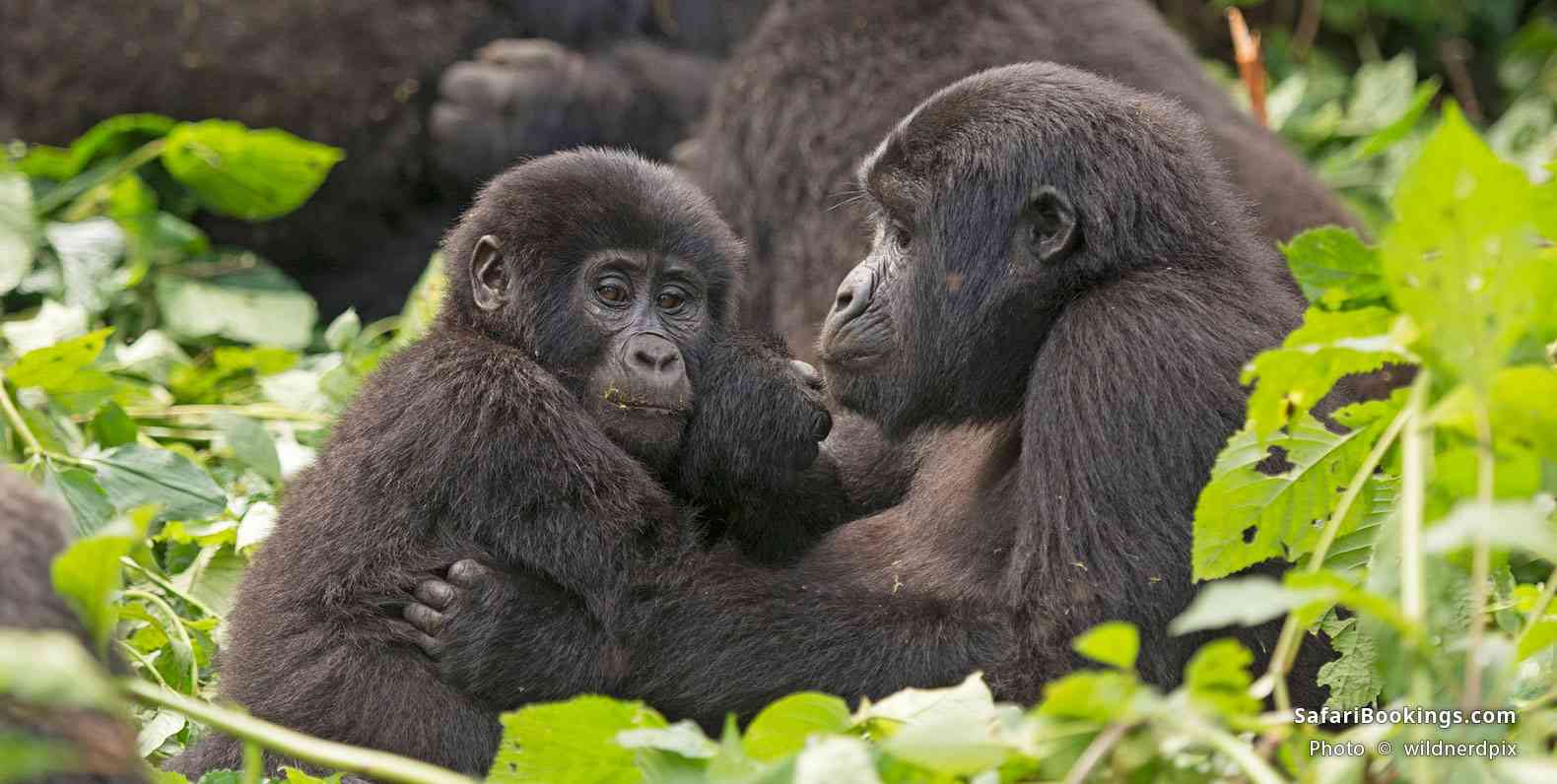
Standing just a few feet from these gentle giants in their forest habitat and seeing them munch on fruit and plants, play together, groom one another, and idly look at the curious bipeds looking at them – these are magical moments that stay with you for a lifetime.
But to get to be in that special place, you first must decide where to go to see them. Do you go gorilla trekking in Rwanda? Or do you go gorilla trekking in Uganda? And if you go to Uganda, there are two gorilla parks, so which should you choose?
Answering these questions is what this blog post is all about. But if you still want to find out more, Contact Us +256781371034 or muganzisafaris@gmail.com
Where gorillas live in Rwanda and Uganda
All of the world’s mountain gorillas live in the mountainous rainforests of NW Rwanda, SW Uganda and the eastern DRC.
The two main countries for gorilla trekking are Rwanda and Uganda, as the DRC isn’t really a safe country for tourists right now. In Rwanda, you can trek to see mountain gorillas in Volcanoes National Park. In Uganda, you can visit them in Bwindi Impenetrable National Park or Mgahinga Gorilla National Park.
“Whether you go gorilla trekking in Rwanda or Uganda, the experience is very similar: you go on a beautiful forest hike to find a troop and spend an hour in its company’’.
Note that Rwanda’s Volcanoes NP and Uganda’s Mgahinga Gorilla NP are actually part of the same ecosystem, and their gorilla troops are able to move freely across an unfenced border.
The mountain gorillas of Rwanda
Rwanda is a small and mountainous country with a population of just 13.5 million people. The main languages are Kinyarwanda (spoken by most citizens), English, French and Swahili.
“Rwanda is sometimes called the pays des mille collines, which is French for ‘land of a thousand hills”.
There’s just one mountain gorilla population in Rwanda, and it lives in the far northwest corner of the country. That corner is dotted by the Virunga volcanic mountains we mentioned earlier. The gorillas living in the forests of the Virungas are protected within the borders of Volcanoes National Park.
Volcanoes National Park
Tourism has played a major role in helping Rwanda to rebuild itself, and mountain gorillas are at the heart of its tourism trade. As mentioned, all of Rwanda’s mountain gorillas live inside Volcanoes National Park.
Rwanda is a small country, and getting to Volcanoes NP is a relatively easy affair.
Visitors to Rwanda simply fly into Kigali International Airport and then it’s a short drive of about two-and-a-half hours northwest to arrive at the doorstep of Volcanoes. Even though the drive is short, it’s always advisable to travel with a reputable tour operator who knows the region and roads well.
“The proximity of Volcanoes National Park to an international airport is a major draw for Rwanda’s mountain gorilla tourism industry”.
The mountain gorillas of Uganda
Uganda is a landlocked country of massive plains, volcanoes, snow-capped mountains, thick forests, savannah, immense lakes, diverse wildlife and more.
As mentioned, there are two mountain gorilla populations in Uganda: one in Bwindi NP and one in Mgahinga Gorilla NP.Each park has its own merits, so let’s look at each in turn …
Bwindi Impenetrable National Park
Most of Uganda’s mountain gorillas live in Bwindi Impenetrable National Park, a UNESCO World Heritage Site.
Bwindi is a beautiful mountain park dominated by thick rainforest. As the name suggests, the forest (or jungle) is a thick tangle of leafy vegetation that can feel impenetrable. Mist and fog abound in Bwindi. Even when the sun is shining above, it can remain fairly dim at ground level.
Mgahinga Gorilla National Park
Mgahinga Gorilla National Park is much smaller than Bwindi and has a smaller mountain gorilla population. This means it sells fewer gorilla trek permits, and is subsequently less well-known and sees fewer visitors.
As we discuss in more detail a little further on, Mgahinga is an ideal option if you want to go gorilla trekking in Uganda but also wish to see endangered golden monkeys or do some challenging summit hikes.
Right, it’s time to go into detail about the pros of each country below, but first, here’s a summary for those of you who just want the Cliff notes:
The pros of gorilla trekking in Rwanda
Let’s consider the ways in which Rwanda pulls ahead in the gorilla trekking race …
1. Rwanda’s gorilla park is much easier to reach
Given the relatively close proximity of Volcanoes NP to Kigali International Airport, Rwanda is a better country for visitors who only have time for a brief holiday to go gorilla trekking.
It takes much longer to arrive at either of Uganda’s national parks with gorillas than it does to arrive at Volcanoes National Park, Rwanda’s one and only park with gorillas.
Folks heading to Kigali for business could actually consider a quick gorilla trek, as you only need one night for it. You would need to overnight near Volcanoes NP, then you start the trek in the early morning and are done by midday-ish. After that, you could drive to Kigali and arrive there by late afternoon.
Both Bwindi and Mgahinga, on the other hand, are in the extreme southwest of Uganda, over 500 km by road from the capital city of Kampala and Entebbe International Airport in south central Uganda.
The roads connecting Bwindi and Mgahinga to Kampala also aren’t a smooth, open highway. So the drive either takes about nine to 10 hours. It’s advisable that you travel with someone who knows the region rather than road tripping on your own.
While you can take a short flight from Entebbe Airport to Bwindi, driving is the cheaper option, especially as part of a tour group. Some who want to go to Bwindi or Mgahinga for gorilla trekking actually choose to fly into Kigali. They then drive north across the border; Mgahinga can be reached in around three hours from Kigali, and Bwindi in about four hours.
2. There are more luxury lodges in Rwanda
If you’re able and willing to pay a premium for accommodation, then you have more high-end choices on the doorstep of Volcanoes National Park in Rwanda than you do next to either of Uganda’s gorilla parks.
If you’re wanting a truly luxurious gorilla trekking getaway, then you should head to Rwanda.
While there are multiple four- and five-star accommodations to choose from near Volcanoes, there are just a handful near Bwindi, and no truly high-end options near Mgahinga. Also, the quality of the four- and five-star accommodations in Rwanda tends to be higher than those with the same ratings in Uganda.
The reason for this discrepancy is that Rwanda decided a while back to target wealthier tourists. You can see this simply in the fact that its gorilla trekking permits are roughly double the price of those of Uganda. Also, you may have picked up that celebrities like Ellen DeGeneres opt to go to Rwanda, not Uganda.
Rwanda’s tourism infrastructure is generally more developed and high-end than that of Uganda.
3. Rwanda is the safer, stabler country
To quote CS Lewis, “Isn’t it funny how day by day nothing changes but when you look back, everything is different?” Who would’ve thought in the 1990s that Rwanda would go on to become one of Africa’s top tourist destinations? It’s now known around the world for its cleanliness, tech innovation, and tourism industry, among other things.
Uganda is also a pretty stable and safe country for visitors. In recent years, there has been a little unrest and the odd sad incident, but these aren’t nearly frequent enough for us to have any qualms about sending clients there, or visiting ourselves. Our staff on the ground are, in addition, always vigilant about keeping guests safe.
The gorilla parks of both Uganda and Rwanda are possibly the safest spots in each country as park rangers patrol the borders twenty-four-seven to protect the endangered primates.
In terms of the Global Peace Index (GPI) scores for 2023, Rwanda scores 2.05, which is higher than Uganda’s score of 2.30. But it’s worth noting that both countries score better than some of the world’s biggest tourist destinations, like Brazil, the USA and South Africa.
The pros of gorilla trekking in Uganda
Let’s now make the case for Uganda’s gorilla trekking offering:
1. Uganda is by far the cheaper option
The main reason that many tourists choose Uganda over Rwanda is that the former offers way more affordable gorilla trekking permits.
Rwanda charges US$1,500 for a gorilla trekking permit. Uganda, on the other hand, charges US$800.
2. It’s easier to get a trek permit in Uganda
Visitors aren’t allowed to visit just any mountain gorilla family on a trek. Only families that have become habituated to the presence of humans (a process that takes park rangers about two years to complete) are visited on gorilla treks. Also, only one group of eight trekkers is allowed to visit each gorilla family per day. This is done to minimize the disruption humans can have on the primates’
environment and daily habits.
These rules apply in both Uganda and Rwanda.
Yet because Uganda has more gorillas – and has subsequently undertaken to habituate more of its families – the country’s authorities are able to issue more trekking permits per day.
In Uganda, about 80 gorilla trekking permits are issued for any given day, compared with roughly 56 in Rwanda. This makes obtaining a gorilla trekking permit in Uganda a little easier, especially if you aren’t booking very far in advance.
If you’re trying to book gorilla trekking permits for a specific date, or fairly last minute, you might not have success in Rwanda, but you could still possibly obtain them for Uganda (or for Bwindi, to be precise).
3. You can spend more time with the gorillas in Uganda
Something on offer only in Uganda is the gorilla habituation permit. This permit allows the visitor to spend 4 hours with a mountain gorilla family in the south of Bwindi. A habituation permit costs US$1,500, which is the same price as the one-hour gorilla trekking permit in Rwanda.
The habituation permit was introduced only recently in response to visitors’ desire to spend more time with the mountain gorillas. Only two gorilla families have been set aside for these habituation experiences. And only about eight habituation permits are issued per day, so you have to book well in advance if you want one.
Visitors who do the four-hour gorilla habituation trek get to take part in activities like mimicking the gorillas’ vocalisations to help find the family, collecting specimens, and even sometimes naming the individual gorillas. It’s a truly standout adventure and ideal for anyone who is a dyed-in-the-wool animal lover.
Just note that the mountain gorillas you visit on a habituation experience could be shyer than those of the habituated troop, especially if you visit them early in the habituation process. This might mean you don’t get as close to them as you would on a regular gorilla trek.
4. Uganda offers more to do after your trek
Straight out of the gate, we want to assure you that there’s plenty to see and do in Uganda! And we’re talking incredible adventure activities, like big game safaris and forest canopy walks,culture , Launch cruises among others.
Also, Uganda has more variety. (Again, Uganda is nine times bigger than Rwanda, so this is to be expected.) In fact, Winston Churchill was so blown away by the beautiful and varied landscapes, wildlife and cultures of Uganda that he dubbed it the Pearl of Africa.
Just a few of the varied and exciting adventure activities you could also do in Uganda before or after your gorilla trek are:
- Do a beautiful forest hike as part of a chimpanzee trek in Kibale Forest.
- Go on a safari boat ride and hike to the top of the powerful Murchison Falls.
- Canoe on Lake Bunyonyi in a dugout and have a picnic lunch on an islet.
- Go white-water rafting on the Nile near historic Jinja.
- Do a game drive in Kidepo Valley National Park to look for lions and other African greats.
- Do a day or multiday hike in the high and ethereal Rwenzori Mountains.
- Abseil down the cliff face alongside the beautiful Sipi Falls.
Gorilla trekking in the Virunga mountains vs Bwindi forest
All of our discussion thus far has been about choosing between gorilla trekking in Uganda and gorilla trekking in Rwanda.Yet for some folks, a more helpful comparison might be one between gorilla trekking in Bwindi NP and gorilla trekking in the Virunga mountains (whether that be in Volcanoes NP in Rwanda or Mgahinga NP in Uganda. We want to briefly look at the differences of each ecosystem to see if these factors (like altitude and further hiking options) might be helpful in allowing you to choose the best gorilla trekking park for you.
So here are three differences between Bwindi forest and the Virunga mountains …
1. Bwindi’s trails tend to be steeper and muddier
We also want to point out that the gorilla trekking routes in Volcanoes and Mgahinga are generally a bit more open when compared with Bwindi. They’re also not usually as steep or slippery as those of Bwindi. Bwindi is known for trails that require you to step over roots, navigate rocks, and more.
Of course, there are many miles of trails in all of the parks, and you hike to where the gorillas are. So this is a generalization, and you could have a very muddy and dimly lit trek in Volcanoes or Mgahinga too.
Yet if you’re nervous of slipping in mud, then perhaps Mgahinga or Volcanoes is the better option. That said, note that you can hire a porter at any of the parks, and they’ll hold your hand to help you with any tricky sections if you like.
2. Bwindi doesn’t require acclimatisation
Volcanoes and Mgahinga have much higher altitude ranges than Bwindi, which can make their gorilla treks a little more taxing on the body. The table below shows the elevation range of each park.
| Volcanoes NP | Mgahinga Gorilla NP | Bwindi Impenetrable NP |
| 2,400 to 3,669 m asl | 2,200 to 3,669 m asl | 1,160 to 2,607 m asl |
If you struggle with high altitude, or aren’t sure how your body will react, you might prefer to go with Bwindi, as there’s little danger of feeling icky from the altitude there.
3. You can do a golden monkey trek in the Virungas and Mgahinga
Endangered golden monkeys live in the Virunga Mountains and Mgahinga. In fact, they live in the forest alongside mountain gorillas.
Excitingly, you can go on a guided hike to visit a golden monkey family and spend an hour in its presence, much the same way as you do with the mountain gorillas (although this trek is much, much cheaper at just US$100). It’s a wonderful additional activity that will let you get to meet not just one endangered primate but two!
Furthermore, because the golden monkeys tend to live lower in the rainforest than the mountain gorillas, doing a golden monkey trek before your mountain gorilla trek helps you to acclimatize.
4. You can do a lot of epic hiking in the Virungas
The Virunga mountains of Volcanoes and Mgahinga offer a different sort of scenery from that of Bwindi.
Bwindi isn’t about high mountains, while the peaks of the Virunga volcanoes are destinations unto themselves.
In Bwindi forest, you’re very much within the trees, while in the Virungas, there’s the chance to climb above the tree line for expansive views. You can also do challenging hikes in the Virungas that take you up above the tree line and into gorgeous subalpine moorland, where you enjoy incredible views of the landscape below.
There are also summit trails you can follow to the peaks of the volcanoes. Some of these have permanent steps in place when there’s a very steep section to navigate. You can see an example of such a staircase in the photo above, which shows hikers nearing the summit of Mt Sabyinyo, the highest of the Virunga volcanoes at 3,669 m above sea level.
You can also do a variety of incredible forest hikes in Bwindi, but they’re nature walks and not summit hikes. Incidentally, the wildlife and birds that you can spot in both the Virungas and Bwindi are absolutely sublime. Bwindi in particular is one of the most bio diverse ecosystems in the world.
Gorilla trekking with Muganzi Safaris is a great idea!
At Muganzi Safaris we tend to take more clients gorilla trekking in Uganda rather than Rwanda simply because the permits are so much more affordable and there are more permits on offer. That said, we also offer fantastic gorilla trekking tours in Rwanda, and those with limited time in the region (or bigger pockets) usually go with this option.
Check out our suggested Rwanda itineraries, all of which include gorilla trekking in Volcanoes. Or, if the info in this blog post has pushed you towards Uganda, please check out our suggested Uganda itineraries, all of which include gorilla trekking in Bwindi.
Please note that all of our itineraries are flexible. For instance, we can take you gorilla trekking in Mgahinga instead of Bwindi, if you like. This is a great option if, as mentioned, you’d also be keen to do a golden monkey trek while in Uganda.
Any questions? Please feel free to call us or drop us a line.
We hope to host you in Rwanda or Uganda soon!